Showing posts with label Noodle. Show all posts

Thursday, August 02, 2012

Vegan Rad Na with Soy Curls

Vegan Rad Na - Thai Crispy Rice Noodle topped with Saucy Stir Fry Veggies and Soy Chicken
Today I am craving for a Thai Noodle dish and decided to make Rad Na which is a crispy pan fried rice noodle topped with stir fry veggies with lots of gravy-like sauce.  If you like gravy or a  thickened sauce on top of a pile of rice noodle, this is a dish you'll like.

Rad Na or Lad Na is a Thai noodle dish influenced by the Chinese culture.  It  is usually made with sliced chicken breast, Chinese broccoli, and mushrooms stir fried in a gravy-like sauce that  is usually made from chicken stock, fish sauce, and oyster sauce (thickened with cornstarch or tapioca starch).   To veganize it, I opted to use Soy Curls instead of Gardein or other chicken substitute.  It is because I just love how Soy Curls soaks up the marinade and spices I used on them.  Of course, tofu can be used also and I recommend 1 box of water packed firm tofu (about 14 oz) to replace the soy chicken.  Or you can omit the soy chicken and double up the mushrooms to be simple and direct.

Rad Na Stir Fry Ingredients, clockwise from top left:  bok choy, onion, oyster mushroom, shiitake mushroom, baby corn, garlic, and soy curls.
To replace the chicken stock or broth, this time I used Bill's Best Chik'nish instead of Better Than Bouillon No Chicken Base because I wanted to control the amount of sodium or salt.  The sauces that I used for this dish is already salty enough.  I am afraid if I use salted vegetarian broth this dish will turn out too salty.   Chik'nish is the only vegetarian broth that has no salt in it so it is my preference to use when I want to watch the amount of salt I put into my dish.

The sauces I used are Thai sauces such as:
Vegetarian Oyster Mushroom Sauce, Healthy Boy brand Black Soy Sauce, and Golden Mountain Seasoning Sauce.
I bought these sauces at a Thai market I visited a while back (or an Asian market may carry these sauces also).  I used a little bit of bean sauce (pictured below with the noodle) that I have on hand, a Chinese style bean sauce.  I usually use this Thai Yellow Bean Sauce, Healthy Boy brand, but I was out of it.  I also love the Sriracha sauce drizzled on top of this dish as a spicy condiment.

I also found BROWN RICE Pad Thai rice noodle (pictured below).  It works great.  This noodle dish usually uses the wide rice noodle that can be found at the Asian market.  However, I wanted to try this BROWN RICE noodle instead.  I was not disappointed.


Vegan Rad Na (Thai Crispy Noodle topped with Saucy Veggie Stir Fry)
Serve 6-8

Stir Fry ingredients:
3-4 large Bok Choy bundle (4-5 cups) or Chinese Broccoli, washed and cut into 3 inches long
5 oz or 1 cup cut baby or mini corn
5 large fresh shiitake or reconstituted dried shiitake mushrooms, sliced
8-10 fresh oyster mushrooms, sliced
5 large cloves garlic, minced
1/2 large onion, sliced thinly
1 Tbsp. Golden Mountain Seasoning Sauce
1 Tbsp. Black Soy Sauce
1 Tbsp. Vegetarian Oyster Mushroom Sauce
2 - 2.5 cups Bill's Best Chik'nish broth
2 tsp. cornstarch or tapioca starch combined with 3 Tbsp. water
1 tsp. sugar (optional)
 Note: I don't usually use sugar but all Rad Na recipes use sugar.  I leave it up to you to use it.
Salt to taste
Note:  I found that all the sauces above provided enough salt so I didn't add any salt.
1/4 tsp. white pepper
1 Tbsp. Canola Oil or Grapeseed oil
Chopped cilantro (optional)
Sriracha sauce (optional)

Preparation of Soy Curls or Tofu:
1/2 pkg Soy Curls (4 oz dry)  or 1 box firm tofu, drained and cubed
3/4 cup Bills Best Chick'nish broth,warmed (omit if using tofu)
2 tsp. Black Soy Sauce
2 tsp. Vegetarian Oyster Mushroom Sauce
1 Tbsp. Cornstarch or Tapioca starch
  1. If using Soy Curls, soak in Chik'nish broth for 10 minutes.  Then, drain the excess broth if there is any.
  2. Mix reconstituted Soy Curls or tofu with black soy sauce, oyster mushroom sauce, and starch.  Mix and set aside.
Preparation of Saucy Stir Fry Veggies with Soy Curls:
  1. Heat a wok or large frying pan and add oil.
  2. Add the minced garlic and sliced onions.  Stir fry until onion is soft, about 3-4 minutes.
  3. Add the prepared or marinated soy curls.  Stir fry until soy curls are brown, about 3-4 minutes.
  4. Add all mushrooms and baby corn.  Stir fry for another minute.  Add a little bit of broth if ingredients stick to the frying pan.
  5. Add the Golden Mountain Seasoning Sauce, black soy sauce, and oyster mushroom sauce.
  6. Add the Chik'nish broth and white pepper.
  7. Let it come to a boil, turn down the heat, and then add the bok choy or Chinese broccoli.  Combine and let it simmer for a minute.
  8. Add the cornstarch or tapioca starch water combo.
  9. Let it thicken and simmer for another minute.  Turn off the heat.

Preparation of Pan Fried Crispy Rice Noodle:
2 pkgs (8 oz each) Brown Rice Pad Thai noodle
4 tsp. Black Soy Sauce
4 tsp. Vegetarian Oyster Mushroom Sauce
Toasted Sesame oil
9-inch flat non-stick frying pan or cast iron pan.
  1. Soak brown rice noodle in warm water for 8-10 minutes (following the directions in the package).
  2. Drain noodle (don't worry if it doesn't look like it is cooked).  Divide into 2 batches for pan frying it.
  3. Heat frying pan in high heat then add 1 tablespoon sesame oil.
  4. Add half of the soaked and drained noodle.  Drizzle 2 tsp black soy sauce and 2 tsp oyster mushroom sauce, combine with noodle.  Stir fry and spread noodle on a frying pan about 1/2 inch thick.
  5. Leave it for 3 - 4 minutes so the bottom is sizzling and crispy before flipping it to the other side.  Don't worry if noodles are sticking to each other.
  6. Let the noodle becomes crispy and brown on the frying pan for another 4-5 minutes. 
  7. Flip on a serving plate.
  8. Repeat step 3-7 for the other batch of noodle.  The pan fried noodle should look like this picture below.
  9. Serve the crispy pan fried noodle with the Saucy Stir Fry Veggie and Soy Curls on top. Add chopped cilantro if desired.  Drizzle with Sriracha sauce and dig in!

Tips on reheating or eating this as leftover:
  1. I found that it is best to pan fry the noodle just before serving.  It is best to pan fry only the amount to be consumed and save the un-fried noodle in  a tight container if  you plan to eat this as a leftover.
  2. The gravy or sauce tends to absorbed into the veggies and soy curls if it is consumed the next day.  You can add more broth and seasonings to produce more gravy. 

Monday, October 31, 2011

Korean Stir-fried Glass Noodle (Vegan Japchae)


I love this dish!  I was first introduced to it in a potluck before I became a vegetarian.  I didn't know the name of the dish but I knew I liked it.  Then, after I became a vegetarian, I saw this dish at Korean markets, packaged in clear plastic containers.  In Korean markets, there is hardly any label or sign in English on the containers.  Again, I still didn't know the name of this dish.  I was afraid to buy it since I was not sure whether beef, shrimp, or chicken broth was used in the cooking process. 

This year I encountered a vegan Korean blog(the one and only, I think): The Vegan 8 Korean.  I love this blog and recommend it to you to check it out if you like Korean dishes.  Voila!  I saw the recipe of the mystery dish and tried it.  It was very good!  This dish is called Japchae.  It is a dish that Koreans brought to parties, potlucks, and community events. The glass noodle is made of sweet potato flour and this kind of noodle is called Dangmyun (as pictured). 

Now, I really appreciate that Sunnie from The Vegan 8 Korean took a picture of the Dangmyun.  Otherwise, I would not have known how to find it in the Korean market.  As I said, usually, there is no translation on Korean products so I am often at lost trying to find the ingredient. As you can see there is no English name on the package although there is a picture of the dish  on the package which helped.
This is different than the Chinese Bean Thread noodle or cellophane noodle that is made of mung bean starch.  The Dangmyun is thicker and stronger.

I also didn't understand why Sunnie stir fried each vegetable individually after each vegetable is cut into matchsticks.   I thought that it will be quicker to do them all together.   I did more research on Japchae and found out the reason from this blog: Herbivoracious who invited a friend, Alice of Savory Sweet Life, to blog about vegetarian Japchae.  She says the following about stir frying each vegetable individually:

"My mother taught me the importance of making sure to stir-fry each ingredient individually.  One could easily be tempted to add all the vegetables at once and fry them together.  But by frying them individually, the flavor and color of each vegetable is preserved without any cross blending of the other ingredients.  As a result, the frying pan becomes more seasoned as layers of umami build on each other.  The final dish is a beautiful medley of noodles, colorful vegetables, and tofu. From an aesthetic point of view jap chae is one of the most beautiful dishes in Korean cuisine."

Right on!  Thanks Alice for the tip.   I agree that this dish is colorful and umami-ful.    I also learned that by reading blogs, I can learn a lot about cooking and ethnicity of a dish.  It is so much fun!

Below is my version of Japchae with Soy Curls.  It is optional for using soy curls. I often make this dish without soy curls, but I think by now, vegetarians and vegans should all learn about how great Soy Curls can be.

Vegan Japchae with Soy Curls (Korean Stir-Fried Glass Noodle)

1/2 pkg. or 4 oz Soy Curls ,soaked in 1 1/4 cup hot water
1 Tbsp. veg broth powder (preferrably not salty one like Chiknish)
2 Tbsp. Hoisin Sauce or Teriyaki sauce
1/2 pkg. or 8.5 oz Dry Sweet Potato Starch Noodle or Dangmyun
Note:  The package I bought is 17.5 oz and I used only  half  a package
1 cup sliced fresh shitake mushroom (I prefer to use fresh but you can use dried shitake mushroom and soaked in hot water for 15-20 minutes)
1 cup fresh baby spinach
1 carrot, sliced into matchsticks
1 red bell pepper medium size, sliced into matchsticks
1 medium onions, sliced
4 green onions, sliced
3 tsp. minced garlic
salt to sprinkle for each vegetable when stir frying
1 tsp. soy sauce to cook with shitake mushroom
5 Tbsp. soy sauce (less sodium kind)
2 tsp. sugar
1 tsp. black pepper (freshly ground)
1 Tbsp. sesame oil
3 tsp. roasted sesame seeds

3 tsp. vegetable oil

  1. Prepare soy curls by soaking it in hot water for 10 minutes, squeezed the water out, add chiknish or non-salty veg powder.  Then, add the hoisin sauce or teriyaki sauce to marinade.  Set aside.
  2. Boil the dangmyun in boiling water for 10 minutes.  Drain, pour cold tap water to stop the cooking process.  Then, drain again. Immediately add 5 tablespoon soy sauce, black pepper, and 2 tsp. sugar into the drained glass noodles and combine thoroughly.
  3. If using dried shitake mushroom, soak the mushroom in warm water for 15-20 minutes.
  4. While waiting for soy curls to marinade and noodle to cool, slice the vegetables.  Drain and slice the soaked mushrooms also.
  5.  
    Stir frying soy curls in my old Chinese wok.
    
  6. Coat a wok or large frying pan with 1 tsp oil.  Put it on a high heat and start with the soy curls.  When soy curl is dry and brown, remove from wok and set aside.
  7. Add onions to the wok. Sprinkle with a little salt, stir fry for 4-5 minutes until translucent.  Remove from wok.  Set aside.  Repeat this process each separately with carrot, red bell pepper, spinach, and green onions.  Everytime, sprinkle a little salt and stir fry until vegetables are cooked.  Add a little water if vegetable sticks to the wok.  You will notice that brown bits are forming in your wok and loosen up when you add water.  That actually adds flavor to the veggies.  When stir frying the sliced mushrooms, add the 1 tsp. soy sauce instead of salt.  Combine and set aside all cooked vegetables onto a large plate.
  8. 
    This is what the cooked vegetable looks like when combined together.
    
  9. Add the rest of the oil (2 tsp.) to the hot wok.  Then, add the minced garlic, stir fry for 1 minute until fragrant, keep stirring to avoid burning.
  10. Add the vegetables, soy curls, and seasoned noodles back to the wok and combine well. Stir fry for a few minutes until noodles are heated through.
  11. Turn off heat.  Add sesame oil, stir, and combine well.  Sprinkle with roasted sesame seeds when serving.

All ingredients combined together and stir fried.

This noodle dish is good at room temperature too.  It is a great dish to bring to a potluck.  DH brought this dish to his potluck at work and he didn't have to reheat it before serving it.  He said that people at his work loved it and a few asked for the recipe.
The Koreans also serve this dish as Banchan which are dishes in small plates (such as tapas) that are served with cooked/steamed rice.  Most of these dishes on small plates are served in room temperature also.
This will be the next dish I will bring to a potluck at work.

Thursday, May 25, 2006

Asian Noodles with Ponzu Sauce, Millennium style


Before I post the Asian Noodles dish recipe, I want to share how I came about making this dish. Recently, I bought 2 new cookbooks: The Millennium Cookbook and Artful Vegan from the Millennium restaurant by Eric Tucker and colleagues. These 2 cookbooks are not for beginner vegan cooks. The recipes are quite extensive and the ingredients used are very extraordinary. The restaurant itself is extraordinary, I heard, although I have never been there myself (planning to be there someday). I thought I already cook gourmet meals but compared to the way I cook, this restaurant really prepares super gourmet meals. The chefs are professionals in the vegan culinary world which I entered only on the edge of it, I think. I can’t imagine what my mother-in-law who lives in the midwest would say if she reads these cookbooks. She said that she enjoys my blogs but doesn’t know half of the ingredients I mentioned in my blogs. These cookbooks use all the ingredients I use and much more. I think vegan culinary world stands on itself as a vast world with no limit. Really, there is no limit of what you can do with fruits, vegetables, grains, seeds, and nuts. A lot of people just don’t know what to do with them but these professionals do.

The ingredients they used that I have never heard of before are like honshimeji mushrooms, mizuna green, black quinoa, and rose geranium (hhmmm…where would I get this). I thought I know a lot about food and culinary world but actually I don’t compared to these professionals. They don’t just use carrots, potatoes, and cabbage like the day-to-day cook in an ordinary family kitchen. They also have an advantage to be at a great location, Northern California, and have a direct contact with local organic farmers who deliver variety of vegetables and fruits, fresh, all year long.

The way Millennium chefs combine fruits and vegetables in making a dish is also amazing. For example, like their salad called Ruby Grapefruit, Avocado and Pickled Red Onions with Baby Spinach and Grapefruit Mojo Dressing, wow, what a name and the picture looks very appealing in this book. Many cookbooks have appealing pictures but the recipes are terrible. However, reading the recipes, I think, I can count on them. The key is to use good quality organic fruits and vegetables to make the recipe right and to adjust the 4 or 5 basic flavors (saltiness, sweet, sour, spicyness, and maybe the 5th flavor: umami or savory) in the recipe to your liking. Everyone has a different degree of each flavor. Eric Tucker, the main Chef, invited his readers to make adjustments and I will do so.

I picked a pretty simple dish for the first time from these cookbooks. The other recipes are not this simple. I have to admit that I appreciate their creativity in combining the ingredients together. The restaurant has an evolving menu which means the dishes they serve are not always the same and they depend on seasonal produce delivered by local farmers (maybe few items in the menu are rotated). According to Eric, the chefs of Millennium conduct a ‘virtual cooking’ where they meet and discuss what they want to do with the vegetables and fruits they received. They have a riffing or jamming with the stuff they have in the kitchen to create the restaurant’s next day menu. It is sort of like musicians composing new songs together. How fun! As their cookbooks reader, I am enjoying reading their creations, singing a new song page after page (although I am not familiar with some of the notes). I didn’t see vegetarian shepherd pie or vegan sloppy joe or tofu pot pie in their cookbooks. I sang those songs before and it is time for me to sing new tunes.

Printable Recipe

Ponzu Sauce
(Adapted from The Millennium cookbook, my changes are in italics)

4 cloves garlic
2 tablespoons coarsely chopped fresh ginger
2 stalks fresh lemon grass, mostly white parts, chopped into ½-inch pieces
1 teaspoon Sriracha hot sauce
¼ cup dry sherry, dry white wine, or nonalcoholic wine
2 cups water
1/3 cup tamari soy sauce
½ cup brown rice syrup

In a medium saucepan, combine all the ingredients and bring to a boil. Reduce heat and simmer for 20 minutes. Remove from heat and strain through a fine-meshed sieve. Let cool and refrigerate in an airtight container.

Asian Noodles with Ponzu Sauce(Adapted from The Millennium cookbook, my changes are in italics)

¾ pound dried soba or udon noodles
2 teaspoons canola oil
2 cloves garlic, minced
6 oz. Fresh shiitake mushrooms or other mushrooms, sliced thin
1 head broccoli sliced into small flowerettes
1 red bell pepper, sliced in thin strips
7 oz. Baked teriyaki tofu (store bought)
Note: I use store bought baked tofu to be simple, the original recipe uses smoked tofu
enough ponzu sauce to cover the whole dish ( about 1 1 /2 to 2 cups)
drizzles of sesame oil (optional)
2 teaspoons toasted sesame seeds

Cook the soba or udon noodles in salted water for about 5 to 7 minutes. Drain and cool noodles.

In a large pan or wok, saute the garlic in oil for 30 seconds. Add the shiitakes, broccoli, bell pepper, and tofu. Saute an additional 2 to 3 minutes. Add the ponzu sauce and bring to a boil. Add the noodles and toss the noodles with ponzu sauce and vegetables. Drizzle some sesame oil and sesame seeds before serving.

Wednesday, April 12, 2006

Vietnamese Salads: Vegan BBQ Noodle Salad and Young Jackfruit Salad


Vietnamese BBQ Noodle Salad
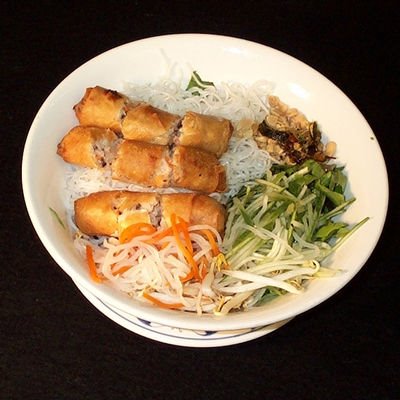
 These Vietnamese salads are excellent for hot weather meals. No, summer is not here yet, we have a bright and sunny spring weather for a change, but I wanted to make them since they are low in fat but delicious. To help me loosing weight, I eat Vietnamese vegan dishes such as Vietnamese Salad Rolls (spring rolls), Vietnamese Pho, and these salads: Vietnamese BBQ Noodle Salad and Young Jackfruit salad(the 2nd picture below). They are yummy and refreshing!
To enhance the BBQ noodle salad to be more nutritious, I use Japanese Zaru Soba which I found in the Korean market near our house to replace the white rice noodle. The Zaru Soba is thin like vermicelli but it is made of wheat flour, buckwheat flour, yam, salt, and water. In fact, I thought it will be good for Pho or any pasta dish that uses white pasta. Zaru means a draining basket made of bamboo which can be used as cooking and presentation according to wikipedia.org (click here for more information).
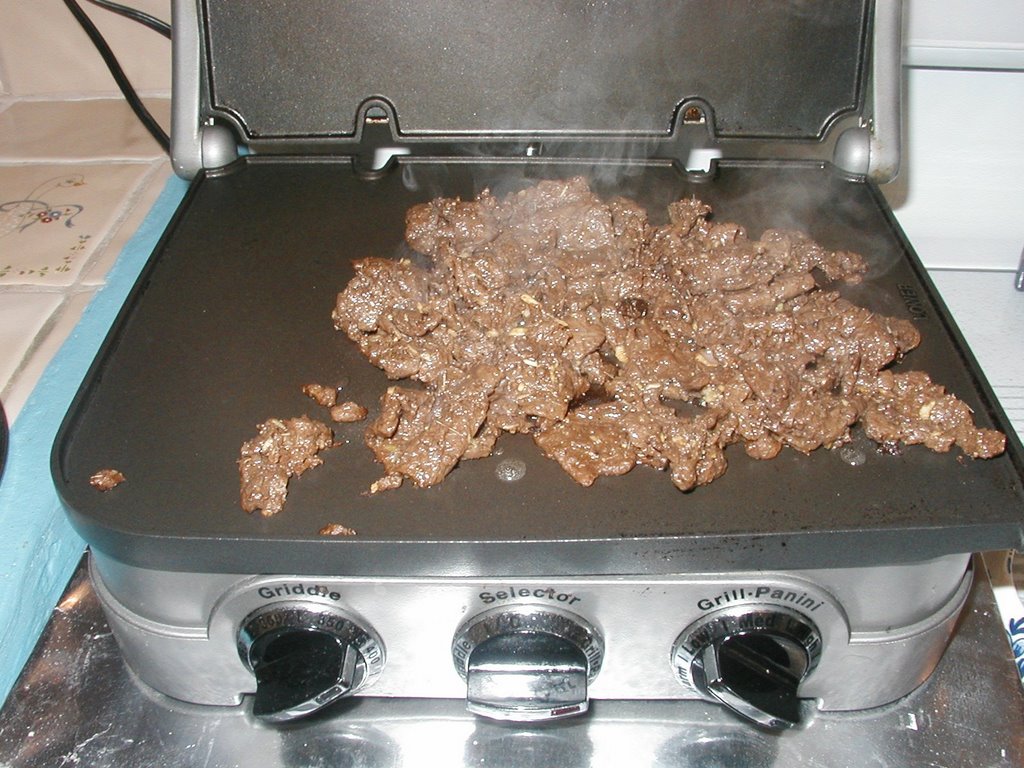
For the Vietnamese BBQ noodle salad, I served the cooked and well drained soba in a bowl topped with fresh vegetables such as thin strips of carrots, thin strips of cucumber, fresh bean sprouts, and fresh mint leaves from our garden. Then, I topped it with grilled marinated Vietnamese BBQ slices made from ‘beefy’ TVP which were grilled on our Cuisinart indoor grill. At the end of the BBQing process, I sprinkled the BBQ slices with roasted rice powder which makes them so tasty.
Roasted rice powder is commonly used in Vietnamese dishes and very easy to make. I pan fried dry (without oi) uncooked rice on a frying pan until they are golden brown. Let it cool and then grind into a powder in a mini blender. This dish is served with sweet and sour dressing on the side. The last topping is chopped roasted peanuts. Pour the salad dressing over the noodle dish just before eating, mix them all up, and enjoy. It is usually served at room temperature which is perfect as a picnic or lunch in the office or travelling dish.
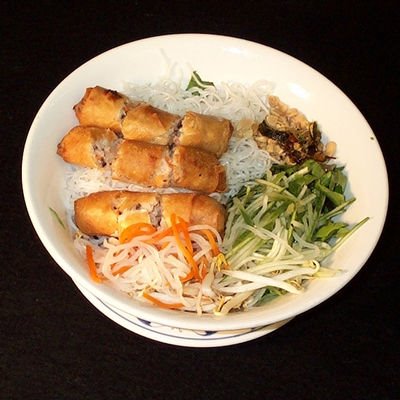
Vietnamese noodle salad is usually served with deep fried Vietnamese eggrolls. It is very yummy but also has more oil and fat content so, at home, I opt to serve without them. In vegetarian Vietnamese restaurants, you can order a combination of eggrolls and BBQ TVP slices on top, a common way to serve it. The salad dressing in restaurants is generally too sweet for my husband’s taste so he usually don’t use much of the dressing. My recipe uses less sugar (I actually use Agave Nectar). It is a matter of taste, you can add more sugar if you want.
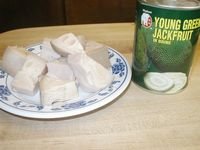
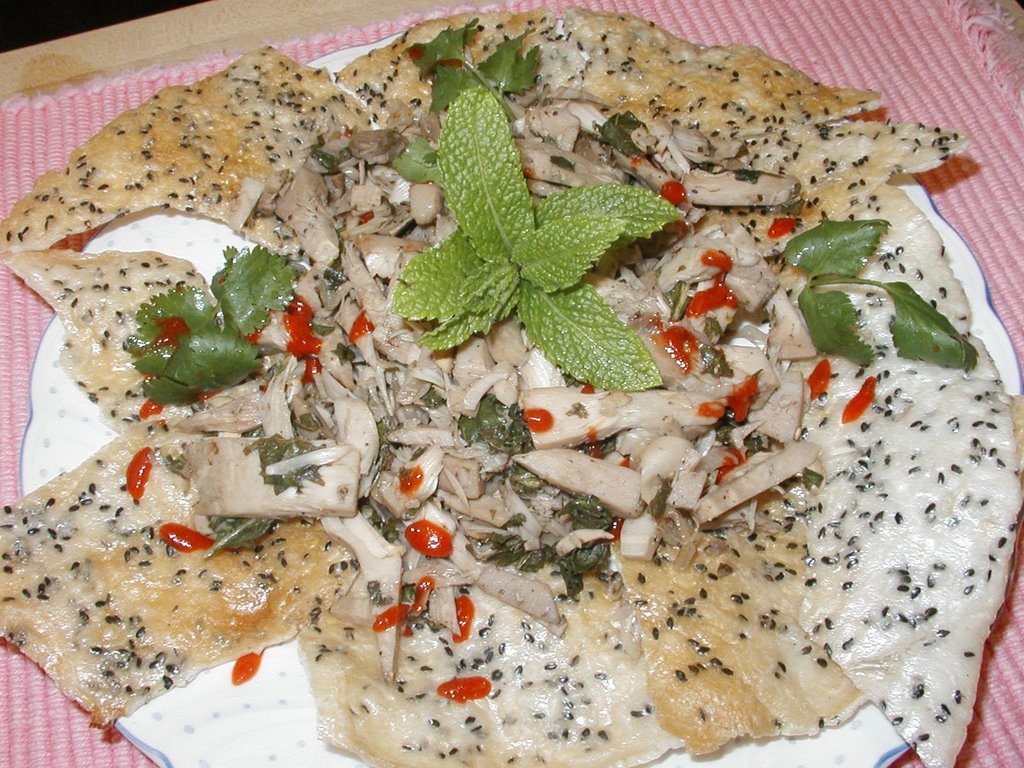
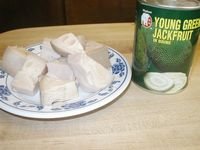
Young Jackfruit salad is unusual for us here in the US. I actually didn’t know about this salad until I became a vegan and explored the vegetarian restaurants near us. Of course, I cannot get fresh young jackfruit here since it is a Southeast Asian fruit but I can buy them in cans soaked in brine at the Asian market. It is the YOUNG jackfruit that I used here and not the RIPE yellow jackfruit which is totally different in smell and taste.
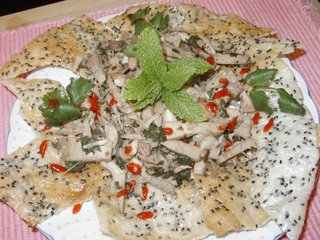
This salad is served room temperature and is sour and refreshing, similar to Thai Som Tum (young papaya salad). It is topped with roasted chopped peanuts, chopped cilantro, and drizzle of fresh squeezed lime juice and Sriracha hot sauce. It is served with Vietnamese sesame rice crackers on the side which are used to scoop the salad with (sort of like eating Mexican Nachos).
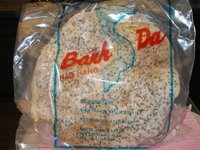
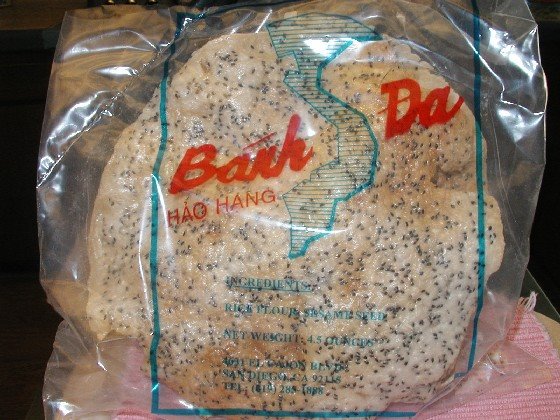
The Vietnamese Sesame Rice Crackers or Chips are also unique and available only in Vietnamese markets. It is called Banh Da and is made of tapioca flour, rice flour, salt, and sprinkled with black sesame seeds. It is toasted or roasted which causes it to puff up and become crispy like chips. This time I bought them ready made from the market.
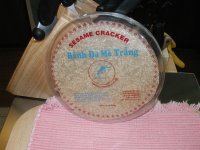
Other times I buy the raw ones in a plastic container which looks like rice papers used for Vietnamese spring rolls. I usually roast these on an open fire or a hot grill. Although this cracker does not look that appetizing on the picture, it is yummy with the salad. If Banh Da is not available, you can substitute it with Indian papadum, Mexican tortilla chips, or Japanese rice crackers.


Vegan Vietnamese BBQ Noodle Salad
I often order this dish in a vegetarian Vietnamese restaurant near my house. The dish is low fat but full of flavor (from the lemon grass and five spice powder). I usually pour all the sweet and sour dressings over the noodles and mix them all together. This is a cold noodle dish and can be eaten at a room temperature which is perfect as a picnic or travelling dish. What makes the BBQ TVP slices taste savory is the dry roasted rice powder which is a common use in Vietnamese cuisine.
Servings: 6
Printable Recipe


Ingredients:
2 1/2 cups dry vegetarian protein meat slices (TVP) or Soy Curls
16 oz Rice noodles (same one use in Vietnamese Pho noodle) or zaru soba
2 carrots, cut into thin strips
1 cup mint leaves, shred into individual leaves
1 cucumber, cut into thin strips
1 cup bean sprouts or shredded lettuce leaves
3 Tbsp roasted rice powder (see tip)
2 tsp canola oil
3 Tbsp roasted peanuts, chopped
Seasonings for marinade:
1/3 cup soy sauce or 2 1/2 Tbsp dark mushroom soy sauce mixed with 2 1/2 Tbsp water
3 tsp sugar or 1 1/2 Tbsp Agave Nectar
1 tsp onion or or 'chicken' or mushroom broth powder
1/2 tsp ground black pepper
1/4 tsp good quality 5 spice powder
1 tsp sesame oil
1 stalk fresh lemongrass, chopped
Sweet and Sour Salad dressing:
1/3 cup water
1/3 cup fresh lemon/lime juice
3 to 4 Tbsp vegetarian fish sauce or Bragg's Liquid Amino
3 Tbsp Agave Nectar or 3 tsp sugar, or to taste
Notes: my husband don't like the sauce too sweet like in the restaurants so I made this sauce more in the sour taste.
1 tsp chili garlic sauce, sambal oelek or Korean red pepper powder, or less for less spicy
  1. If using dry TVP slices, simmer the dried veg protein in warm water for 20 to 30 minutes. Then, squeeze all the water out. Or, an alternative method which I like is to pressure cook the dry TVP slices in 3 or 4 cups water on high for 2 minutes. Then, use the quick release method. The TVP slices will be very soft. Let it cool and then squeeze the water out.
  2. If using soy curls, reconstitute them with 2 1/4 cups of hot water for 10 minutes. Then, squeeze the water out.
  3. Combine seasonings for marinade in a blender including the chopped fresh lemon grass stalk. Blend the sauce until well blended and the lemon grass is pulverized into very small bits.
  4. Mix the seasoning sauce with the veg protein (reconstituted tvp or soy cutlets) to marinade for at least 1 hour.
  5. Meanwhile, cook the rice noodles in a hot boiling water for 1 minute (or soba for 4 minutes). Take it off heat and soak for a few more minutes. Test if the noodle is soft. When the noodles are soft, drain it over a colander and rinse it with cold tap water so it will stop the cooking process.
  6. Heat your indoor bbq grill or a heavy skillet like a cast iron, high heat.
  7. Saute the marinated protein slices. Drizzle canola oil to prevent sticking. Cook until they are brown and looked like they have been barbequed. I use an indoor BBQ grill with less oil.
  8. Remove from heat. Add 3 Tbsp of roasted rice powder and mix well. Serve in a bowl on top of the drained rice noodle or soba and vegetables with Sweet and Sour dressing on the side. Sprinkle the roasted chopped peanuts on top
Nutrition Facts
Nutrition (per serving): 460.1 calories; 11% calories from fat; 5.9g total fat; 0.0mg cholesterol; 1499.5mg sodium; 475.2mg potassium; 84.3g carbohydrates; 2.3g fiber; 13.9g sugar; 82.0g net carbs; 25.4g protein; 9.2 points.
Cooking Tips for Roasted Rice Powder: Dry fry rice on cast iron pan in medium heat until rice became opaque and light brown, about 5 minutes. Let it cool. Grind in a mini blender or a spice grinder until it becomes a powder.


Vegan Vietnamese Young Jackfruit Salad
This young jackfruit salad is served at a vegetarian Vietnamese restaurant near my house. It is sour, a bit sweet, and spicy like Thai Somtum (young papaya salad). It is served on top of Vietnamese sesame chips that are available in Vietnamese markets but it can be substituted with Indian pappadums. Originally, it is made with fish sauce but I am able to substitute is with vegetarian fish sauce. Bragg's Liquid Amino tastes similar to vegetarian fish sauce and can be used for this dish. With drizzles of Sriracha hot sauce, roasted peanuts, squeezed lime wedges, and chopped cilantro, this dish is crunchy, delicious, and refreshing.
Servings: 6
Printable Recipe

Ingredients:
2 cans young jackfruit in brine (each can is 8 oz drained weight, total = 1lb.), drained,rinse in water, squeeze out the water and cut into strips (vertically according to its grain)
2 tsp. canola oil
4 cloves garlic, minced
3/4 cup shallots or green onions, chopped
1 cup Thai/Vietnamese basil, loosely packed, chopped
1 tsp. sea salt
1/2 tsp. black pepper
1 Tbsp. vegan sugar
2 1/2 Tbsp. Vegetarian Fish Sauce or Bragg's Liquid Amino
1 to 2 Tbsp. fresh lemon juice
1 tsp dulse granules
Serve with:
1/4 cup roasted peanuts, chopped
1/4 cup cilantro, chopped
1/4 cup Thai/Vietnamese basil, chopped, optional
Fresh lime wedges, Sriracha hot sauce, Vietnamese sesame chips or Indian Pappadum
  1. Preheat wok. When the wok is hot, add oil, garlic, and onion. Stir fry until fragrant. Add young jackfruit strips, salt, sugar, black pepper, and vegetarian fish sauce or liquid amino. Mix and stir-fry in high heat for 10 minutes until spices are absorbed to the jackfruit. Add water to the wok to prevent sticking.
  2. Add 1tsp. dulse granules, mix well. Stir fry for 2 minutes.
  3. Add lemon juice and Thai/Vietnamese basil. Mix well for 1 minute.
  4. Turn off heat. Set aside jackfruit in a bowl and let it cool.
  5. Serve the salad room temperature on a plate with chopped roasted peanut and chopped cilantro/basil sprinkled on top.
  6. Dot it with Sriracha hot sauce on top and all over the salad. Each person can use the sesame crackers/pappadum to scoop the salad, dot with fresh squeezed lime juice and more vegetarian fish sauce.
Nutrition Facts (without sesame crackers): (per serving): 157.3 calories; 26% calories from fat; 4.9g total fat; 0.0mg cholesterol; 484.9mg sodium; 424.8mg potassium; 28.3g carbohydrates; 2.6g fiber; 2.8g sugar; 25.7g net carbs; 4.0g protein; 3.0 points.